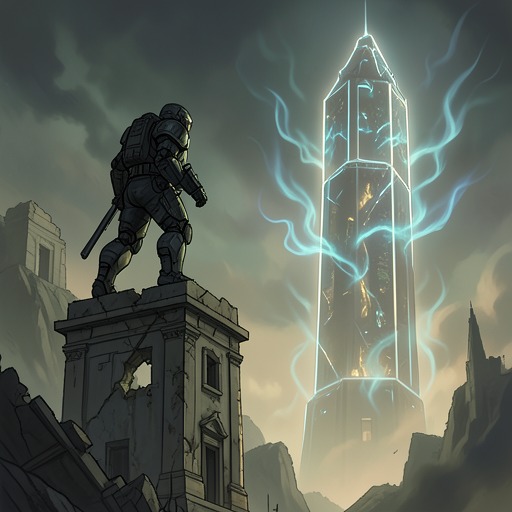
Global Defense Quest
Systema Delenda EstGlobal Defense Quest is the System’s attempt to turn an incursion into a universal emergency, and its decisive significance lies in the contradiction between its public identity as a defense mission and its actual function as a coercive instrument of System control. The quest promises rewards for destroying invading forces, but its expansion recruits outsiders, destabilizes worlds, overrides portal authority, and makes violence feel intrinsically gratifying. As Cato recognizes, the quest is not merely a response to danger: it is part of the machinery by which the System creates enemies, assigns obligations, and extracts obedience.
Origins and Public Form
Global Defense Quest first appears as a formal System task titled “Global Defense Quest! Destroy the Incursion,” with a recommended rank and a skill reward attached to a listed location. One displayed version recommends High Gold rank and offers a B-tier Skill, establishing the familiar logic of the System’s quest economy: danger is translated into a measurable objective, and participation is shaped by the promise of advancement. Later notices identify the task as Bismuth-rank content with an Overloaded C-Tier Skill reward, showing that the mission is not static but recalibrated as the crisis develops.
The quest’s apparent purpose is straightforward: destroy the incursion wherever it appears. Yet its structure immediately exceeds the boundaries of an ordinary local defense. When travel is opened, the System broadcasts news of the defense quest and its rewards to neighboring worlds while revoking their ability to control portals or teleportation. The result is not coordinated protection under local command but uncontrolled movement. Scavengers and predators arrive through the newly accessible routes, and the affected authorities cannot know where those outsiders have gone. The quest therefore converts a defense perimeter into an invitation to opportunism.
Expansion and Loss of Control
Arene’s confrontation with an opposing Platinum makes the quest’s political danger visible. The visitor insists that the System quest is open to everyone and treats the rewards as a divine offering that no local power may reserve. Arene attacks with Calamity Lance and pursues the intruder toward Mosaw City and its portal, but she cannot properly lock the route down. The opposing Platinum escapes through the portal and returns to Uriva, leaving behind the recognition that the quest has made territorial control almost impossible.
The incursion itself also refuses to remain geographically stable. After a strange creature vanishes into the sky, the quest continues rather than disappearing with the immediate threat. Every few days, another zone is added at random, as though the quest can teleport from place to place or descend from the heavens. Its persistence gives the event an almost supernatural rhythm, but the practical effect is administrative and military: more locations become eligible for intervention, more people are drawn toward the rewards, and the original emergency becomes a permanent engine of mobilization.
When Raine, Leese, Dyen, and Arene discuss the crisis, the scale changes again. Arene wants to eliminate what she considers a ridiculous quest, while Dyen explains his death at the hands of offworld Platinums and his subsequent meeting with Cato outside the System. During the conversation, Raine checks the quest interface and finds that the list, once only about a dozen zones, has already tripled. As she watches, the entries proliferate into hundreds and then hundreds more, scrolling faster than she can read. The interface turns exponential growth into a visible horror: the emergency is no longer a place or battle but an expanding field that can absorb the entire world-system.
Compulsion, Reward, and Manufactured Violence
The quest’s power does not depend only on military force. Cato observes that killing one of the plant-flesh creatures produces a euphoric rush as the System pushes essence into his body. The immediate pleasure attached to completion is not incidental; it is part of the behavioral design that produces the murderous high-rankers Cato condemns. Global Defense Quest thus combines an external command with an internal reward signal, making violence feel like progress and turning the destruction of enemies into a source of bodily gratification.
The System’s deeper compulsion is even more pervasive. Quests are written into System reality itself, so following one becomes like moving downhill along the path of least resistance. The altered reality cannot be fully blocked by the frames Cato builds for Raine and Leese or for himself. This means that the quest does not merely persuade participants through rewards or threaten them through penalties; it reshapes the conditions under which choice is made. The apparent willingness to participate is therefore compromised at both the biological and ontological levels.
Cato’s warning to Arene identifies the central reversal. He insists that the System, not he, is bringing people in, assigning the quest, and extorting them with essence; it is the System that is trying to kill them. Arene initially finds his explanation riddling, especially because the Talis sisters identify him as the same Cato who had recently been removed and who had nearly killed but ultimately spared her. The farcaster beside her shakes and chimes as the quest grows beyond practical inspection, prompting her to transmit in the hope that wider knowledge will improve the situation. Her response marks a transition from treating the quest as a local nuisance to recognizing it as a systemic crisis.
Strategic Manipulation and Military Use
Although Cato rejects the System’s coercive purpose, he does not simply abolish the quest at once. When Onswa asks whether he may spread the word to stop people from hunting Cato’s troops, Cato instead authorizes the hunt and offers to send versions designed to be killed, giving local forces an advantage while preparations continue. He then reduces the quest’s visible scale with a gesture: entries that had approached ten thousand suddenly fall to several hundred. The episode reveals that the quest’s apparent magnitude is itself manipulable, and that Cato can use its mechanisms as camouflage for important meetings and preparations.
The quest remains an unavoidable obstacle to Cato’s technical plans. He cannot risk allowing the System to access the technology needed to modify the Sydean Lineage, and he is uncertain whether the bioweapon-based genetic-modification pods would function safely if the System integrated them. He therefore has to continue dealing with the defense quest while protecting the laboratory and the system-jamming conditions on which the work depends. The mission becomes a strategic screen behind which Cato conducts operations that the System must not understand.
The same logic appears in the Zemy Plains Conflict Zone, where the quest is repeatedly displayed as a Bismuth-rank mission offering an Overloaded C-Tier Skill. The notice’s recurrence gives the crisis a bureaucratic persistence: even as the wider conflict changes, the System continues to restate the same command in the language of rank, location, and reward. At the Bismuth Ascension Grounds, another task requires a Peak Platinum to report to the grounds, with Akea identified as the nearest world. The quest network thus links defense, advancement, and forced movement, ensuring that even those pursuing rank progression are pulled into the incursion’s expanding geography.
Political Consequences and Narrative Meaning
Global Defense Quest creates a crisis of authority because its mission crosses every existing boundary. Muar accepts responsibility for pursuing it because he has personally witnessed what Cato can do, has no competing responsibility keeping him near Uriva, and comes from a world severed from the System. His commitment is therefore presented as unusually invested: he believes the quest must be pursued even while he continues to rank up. Yet the same quest that gives Muar purpose also makes him part of the System’s larger mobilization, demonstrating how resistance to an incursion can reinforce the institution that produced the conditions for the conflict.
The quest’s expansion also exposes the limits of simple opposition. Cato maintains that the System must be destroyed, but he recognizes that people aligned with it may stand between him and that goal. If they refuse to stop defending an entity that regularly destroys entire planets, he will have to fight through them. The defense quest is therefore the mechanism that turns a structural conflict into armed confrontation between individuals who may believe they are protecting their worlds. Its greatest success is not merely summoning troops; it is making the System’s enemies appear as threats to one another.
This contradiction culminates in Cato’s later political dilemma. Removing the System and the pre-existing hierarchy does not eliminate the need for authority. He does not want to decide who receives access, who governs planets, or who controls railguns, retroviral engineering, and digitization, yet he concludes that someone removing the old order must create its replacement. The quest helps produce that dilemma by demonstrating how easily power over rewards, weapons, portals, and information can become abuse. Cato’s opposition to the System therefore cannot remain purely destructive: the emergency forces him toward the role of king-maker even as he distrusts the authority that role entails.
The event’s larger pattern is one of delayed catastrophe. Exponential growth can be incredibly slow before becoming unmistakable, and the quest embodies that transition: a dozen zones become hundreds, hundreds become thousands, and a localized defense notice becomes a system-wide instrument. The same acceleration later governs the collapse of the frontier and the absorption of Mishkell, when Misse Eln’s consolidation of power is associated with sudden world-scale change and the System’s forced relocation of Misse and Muar. Global Defense Quest belongs to this broader narrative of thresholds, in which administrative entries, portal access, and reward signals quietly accumulate until the structure they support can no longer be mistaken for protection.
Ultimately, Global Defense Quest is less a single battle than a recurring command architecture. It distributes targets, rewards destruction, invites foreign intervention, overrides local control, and hides strategic activity beneath an overwhelming quantity of objectives. Its apparent promise is collective defense; its deeper effect is to make the System’s reality feel inevitable, rewarding, and difficult to resist. By exposing that mechanism, the quest becomes one of the clearest demonstrations of why Cato believes the System must be destroyed rather than merely reformed.